
Check Dialer Status If the dialer status shows Active (green), the dialer is connected and ready to make calls. If it shows Inactive (red), this may indicate an issue with the microphone, audio device, browser permissions, or device configuration.
If a call shows as answered but you cannot hear the other party, the audio cuts out, or the call has no audio, please follow the troubleshooting steps below.
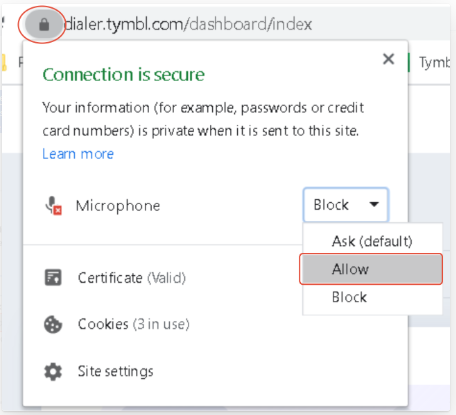
a. Check Browser Microphone Permissions
b. Click the Lock icon located in the upper-left corner of your browser.
c. Click the dropdown menu next to Microphone.
d. Select Allow and reload the TYMBL page and try making another call.

2. Check Your Headset and Audio Devices
If you are experiencing a “Microphone device error” or are unable to make calls, the issue may be related to your headset, microphone settings, or another application using the audio device.
Please try the following:
a. Make sure your headset is powered on and connected before logging in to TYMBL or making calls.
b. Confirm that your headset is selected as the correct Microphone/Input and Speaker/Output device.
c. In the upper-right corner of the dialer, click the Audio option and check the Microphone and Speaker dropdowns. Make sure the correct headset or audio devices are selected, and adjust the settings if needed.
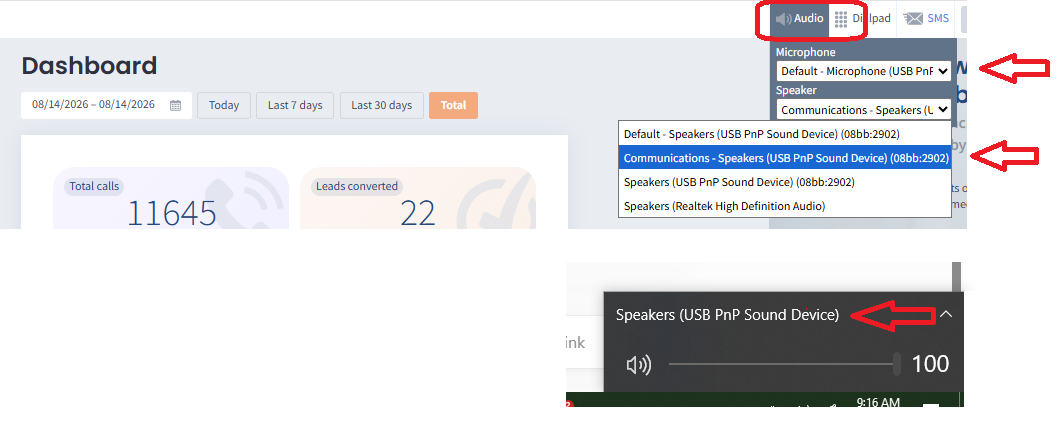
d. Check for other connected audio devices, such as a webcam or Bluetooth headset, that may be selected instead of your primary headset.
e. If Bluetooth is enabled, try temporarily turning it off and reconnecting your headset.
f. Close other applications that may be using your microphone or headset, such as Zoom, Microsoft Teams, or Google Meet.
g. Restart your headset or audio device and try making a call again.
h. If possible, test with a different headset to determine whether the issue is related to the device.
i. Run the Pre-Call Test to confirm that your microphone and other hardware meet the required specifications.
j. If you receive an access denied prompt, make sure you allow microphone and camera access, then try making a call again.
A “Microphone device error” generally means that TYMBL cannot access your microphone. This can happen if the microphone is being used by another application, the wrong device is selected, or access to the microphone has been restricted.
After completing the steps above, please try making a call again.
Important: If the headset is turned on after TYMBL has already been opened, the system may continue using another available audio device, such as the webcam microphone. This can cause the dialer to become inactive or result in missing audio.
3. Check Your Internet Connection
A weak or unstable internet connection can cause audio to cut out, become distorted, or result in one-way audio.
a. Check your current internet connection.
b. If possible, temporarily switch to a backup connection or mobile hotspot and test another call.
c. If the issue occurs only on one network, the network may be contributing to the problem.
4. Restart Your TYMBL Session
Please start with the following basic troubleshooting:
a. Log out of your TYMBL account.
b. Close the browser completely.
c. Reopen the browser and log back in.
d. Try making another call.
If the issue persists, try using Google Chrome, as TYMBL works best with Chrome. You can also try using Incognito Mode to rule out browser extensions or session-related issues.
5. Check Your VPN
If you are using a VPN, temporarily disable it and try making another call. VPNs can sometimes affect connection quality and call audio.
6. Test With a Regular U.S. Number
Try calling a regular local U.S. number to determine whether the issue occurs with all calls or only with certain numbers.
Please note whether:
a. The call connects successfully.
b. You can hear the other party.
c. The other party can hear you.
d. The audio cuts out after the call connects.
e. The issue occurs with both live answers and voicemail.
This will help determine whether the issue is related to the audio device, connection, or specific calls.
7. Check for Dialer Errors
If the problem continues:
a. Make another test call and reproduce the issue.
b. Press F12 on your keyboard.
c. A developer tools window should appear.
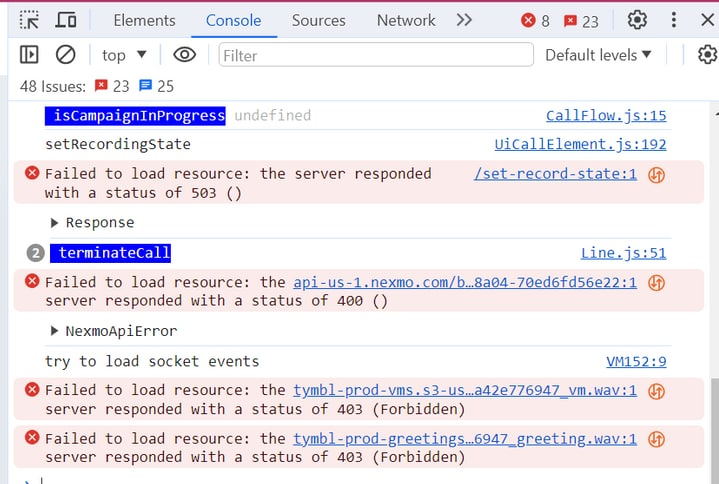
d. Select the Console tab.
e. Look for any errors displayed after the failed call.
f. Take a screenshot of the Console and send it to support for further investigation.
If possible, also provide the date/time of the failed call and the number dialed, so the call can be investigated more accurately.
Example:
8. If the Website Is Slow or Lagging
If TYMBL is also running slowly or becoming unresponsive:
a. Close unnecessary browser tabs and applications.
b. Restart the browser.
c.Try Google Chrome or Incognito Mode.
d. Disable unnecessary browser extensions.
e. Check your internet connection.
f.Test TYMBL on another network or computer, if available.
If the website remains slow after these steps, please report the issue separately so the platform performance can be investigated.
9. When Escalating the Issue
If the problem continues after completing the steps above, please provide:
a. Browser and version
b. Computer/operating system
c. Headset make and model
d. Wired or Bluetooth headset
e. Whether a VPN is being used
f. Whether other calling applications are running
g. Date and time of the failed call
h. Number dialed
i. Whether the issue affects live calls, voicemail, or both
j. Screenshot of any Console errors
This information will help the technical team determine whether the issue is related to the audio device, browser, network, account, or TYMBL's calling system.